Swedes – and especially Swedish women – are known worldwide for their good looks. If you asked 100 men anywhere in the world what spontaneously comes to mind when they think of Sweden, I’d assume a significant number of them would reply “good looking blondes” … right after ABBA and IKEA. ;)
Long blonde hair is a stereotypical feature of many Swedish women. While not all Swedish women are naturally blonde – many have given nature a helping hand – it is certainly not uncommon to see such a typical Swedish woman walk past you on the streets of Sweden.
Swedish men are of course blonder as well – but more rarely use dye to enhance their bright-hair appearance.
Are Swedes really that blonde?
Yes. But of course not all Swedish women are blonde. Compared to Germany, I’d say they are blond-er. In fact most of the blondness you see in Swedish women’s hair is intensified by dye. About 50-80% of the swedish population have, depending on the region, natural bright hair.
I’ve also found that Swedes have a different threshold for dark hair; shades they consider dark often look dark blonde or light brown to me.
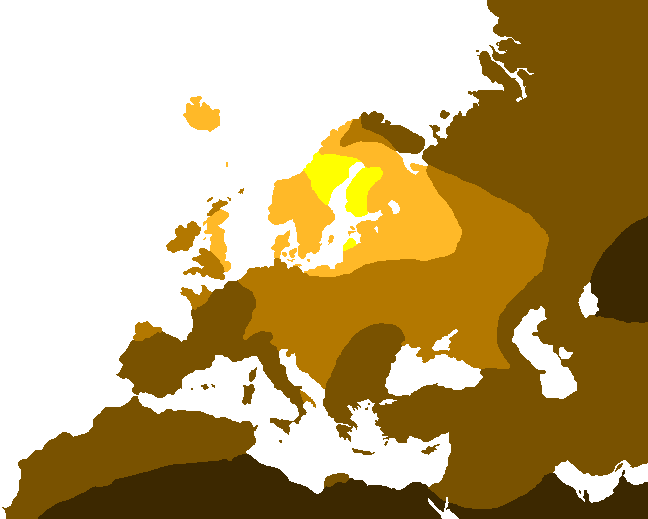
Only about 2% of the world’s population is blonde – a figure that includes darker blonde shades as well. Not surprisingly, the highest concentration of blonde, blue-eyed, and light-skinned people is found right in northeastern Europe.
Blondes in the world: „Weltkarte-Haarfarben“ von Ökologix – Eigenes Werk. Lizenziert unter GFDL über Wikimedia Commons
The origin of blonde hair
Anthropologists believe that a genetic mutation occurred among originally dark-haired populations between 20,000 and 40,000 years ago. It is suggested that individuals carrying this mutation – which is also responsible for light skin pigmentation – were better able to spread into northern regions with lower levels of solar radiation. Light-skinned people are more sensitive to UV radiation – levels of which increase in more southern latitudes – than those with dark skin. In contrast, blonde, light-skinned individuals have the advantage of producing more vitamin D even in low-light conditions, which provided them with an evolutionary advantage in northern regions.
So, I guess one can call Swedes “efficient vitamin D producers” then. ;)
The claim that blonde hair color is in danger of extinction is also rejected by scientists.
By the way, two dark-haired individuals can have a blonde child if one of them carries a corresponding, suppressed “blonde allele.” The myths that two naturally blonde individuals cannot have dark-haired offspring is wrong – a misconception derives from outdated school biology. Which changes how you look at blonde couples with dark-hair kids, doesn’t it? :D
Fun fact: “rat-colored” hair
The color when Swedes have dark-blonde hair is often called in a not-so-flattering way: råttfärg, rat-color.





.png)